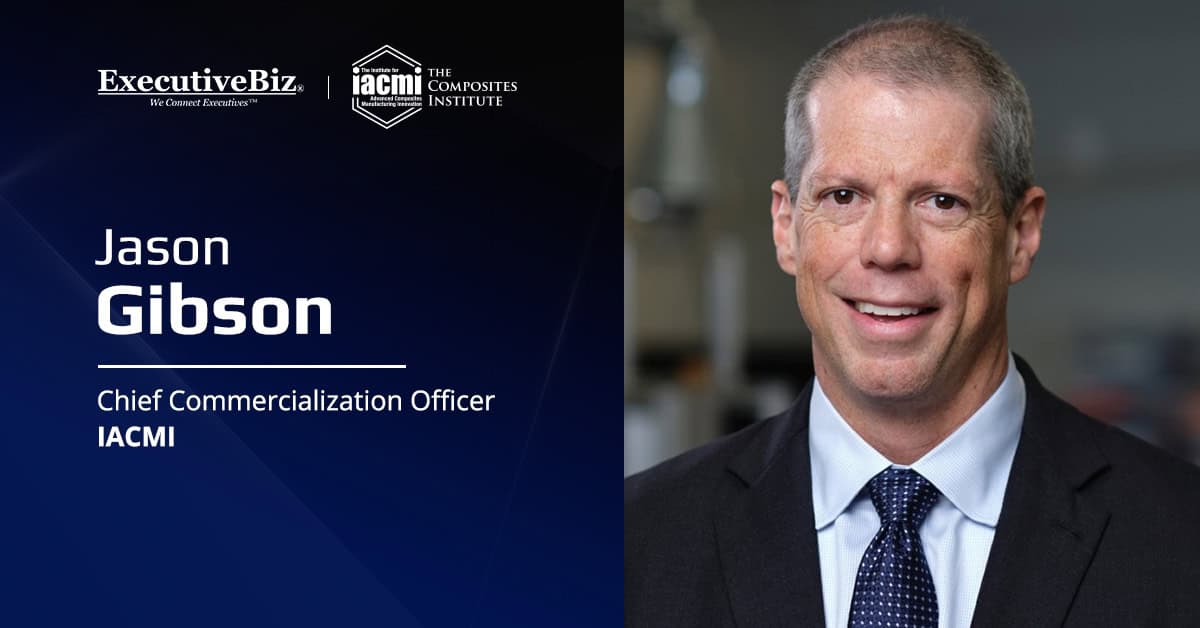
Promising technologies often stall in the gap between a successful research project and a product that can be manufactured at scale. Research communities refer to this gap as the “valley of death.” Helping technologies bridge that gap has been central to the mission and work of the Institute for Advanced Composites Manufacturing Innovation for more than a decade. In a recent Executive Spotlight interview with ExecutiveBiz®, Jason Gibson, IACMI’s chief commercialization officer, discussed this struggle and outlined his plan to address it.
Gibson is leading IACMI’s effort to build a fully domestic supply chain for silicon carbide fiber, a material that can withstand extreme temperatures (around 2,700 degrees Fahrenheit). The Pentagon needs this type of material for hypersonics and other extreme-heat applications, but it is expensive and the U.S. has little capacity to produce it. To address this, Gibson has a three-goal initiative: reduce reliance on foreign precursors, lower costs by 80 to 90 percent, and increase domestic production capacity tenfold. He stated that IACMI’s Carbon Fiber Technology Facility at Oak Ridge National Laboratory could produce the fiber with minor modifications.
“We’re very good at funding early-stage research, but we need to put more emphasis on the middle: scaling up, demonstration, qualification and first adoption,” Gibson said. “A technology isn’t successful just because it works in a laboratory.”
Below is an excerpt of the interview. Read Pat Host’s full Executive Spotlight on ExecutiveBiz®, originally published on October 21, 2026.
###
ExecutiveBiz: What exactly is silicon carbide technology?
Jason Gibson: Silicon carbide technology involves taking a pre-ceramic material and pyrolyzing it. In some applications, you also have to re-densify it.
One unique aspect of silicon carbide is that you can use silicon carbide fiber to reinforce it, which gives it much greater structural rigidity. However, it’s very expensive, and there’s not much production capacity in the U.S. today, especially when it comes to the fiber.
Because of our Carbon Fiber Technology Facility at Oak Ridge National Laboratory in Tennessee, we have the ability to produce silicon carbide fiber on a line like that with only minor modifications. It’s unique that we have the capacity to do that today.
We’re looking to launch a project to develop a precursor, optimize it for scalability, cost reduction and performance, and then prove it out at scale. That would help open up the market for these high-temperature applications.
There are nuclear applications, compressor blades for aircraft engines and energy generators, including turbines, as well as hypersonic applications.
EBiz: Which emerging composite technology are you most excited about right now, and how close is it to real government deployment?
Gibson: One area I’m particularly excited about is advanced high-temperature materials, including the silicon carbide fiber project I mentioned, as well as carbon-carbon composites.
These materials are increasingly important for hypersonics, propulsion and other extreme-temperature defense applications, and the applications are real today. The bigger challenge is establishing the domestic supply chains, manufacturing capacity, and cost structure necessary to deploy them at a meaningful scale. That’s exactly the kind of problem where organizations like IACMI can help bridge the gap.